More information
Main author
Kalthoff W.
Co-Authors
Boström K.J., Mühlbeier A., de Lussanet M.H.E., Wagner H., Castro W.H.M
Type of media
Publication type
Lecture
Publication year
2019
Publisher
28 EVU Conference, Barcelona
Citation
-
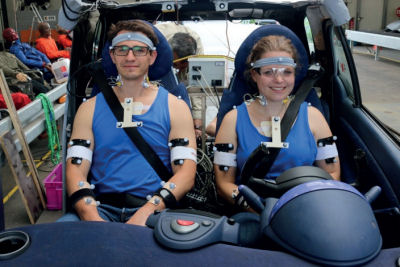
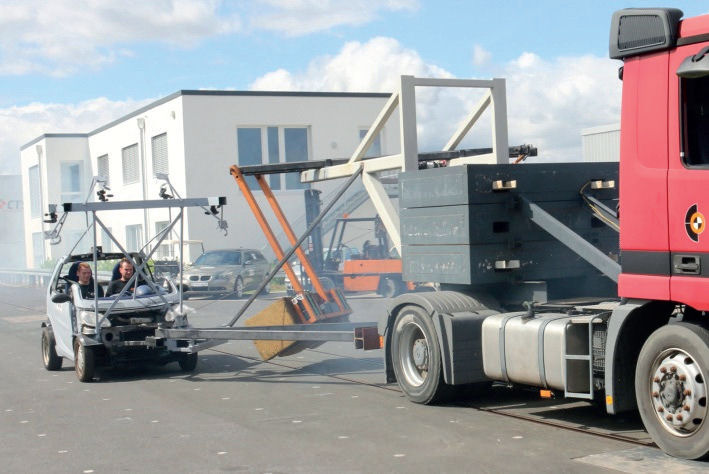
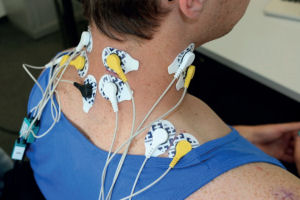
This article presents the first results of a study whose experimental set-up was described in detail at the EVU conference 2017. During the tests, a Smart Fortwo passenger car was pulled by a truck and hit with a pendulum at an angle of 45°. The change in velocity of the car was about 3 and 6 km/h. 66 volunteers participated at the experiment. Furthermore, two dummies were used. In total 446 tests were carried out, which corresponds to 892 single trials. Each subject experienced about 10 to 18 impacts during the experiments. Of the total of 66 subjects, only 3 subjects had minor complaints after the experiments. Overall, the kinematic values increased with the strength of the collision. The same applies to the reflex amplitude. Tense pre-collision posture leads to increased reflex amplitude and delay in electromyography (EMG) compared to the relaxed condition. Thus, in the relaxed condition muscle activity starts earlier. The occupants were able to reduce their head displacement by a tense posture. In the secondary phase, the head movement is at least as pro-nounced as in the primary phase. The influence of the seat belt is low at the present speed level. Nevertheless, differences are recognizable. The tested dummies cannot realistically reflect the movement kinematics of the human cervical spine.
(EVU-members can download the full article)